The history of this research.
I first worked with Amish and Hutterite settlements in the Midwest in the early 1980s. I would describe myself today as a midwife-turned-anthropologist, turned author and doula. During my years in Minnesota, Wisconsin, and North and South Dakota, I observed under-served populations of mothers and children, and mis- and undiagnosed genetic disorders which disturbed me very much. I was granted a Bush Leadership Fellowship in 1989 which enabled me to complete an internship in midwifery at a free-standing birthing clinic in El Paso, Texas, which also served the neighboring city of Ciudad Juarez, Mexico, and prepared me for the Texas State midwifery boards and licensure held that same fall in September, 1989. (Also see under March stories at this blog the story called, "What a midwife should not do: A lesson in destroying bonding.")
My grant from Bush also gave me the credentials that I needed to be accepted into the medical community, who in turn gave me unconditional backup and support for my work. With that support I was able to identify Amish women who had experienced multiple stillbirths and with appropriate referral were able to receive early intervention during subsequent pregnancies and now have healthy (grown) children. The isolated Hutterian communities had more complicated histories compounded with intermarriage and a mistrust of the medical facilities in their districts. As a woman I was able to gain their trust and teach childbirth education, self-breast examination (which none had
ever been introduced to), and perform pap tests, often for the first time, for the women of all ages in each colony I visited, with laboratory back-up in Minneapolis.
In 1970 - '71 I worked with Mother Teresa of Calcutta and upon her death in September 1997, reflected on that experience in an article (Plough Publishing, November, 1997) and in a public lecture later that fall in New York City sponsored by The Samuel Dorsky Symposium on Public Monuments Spirituality Symposium at Columbia University. I believe this amazing opportunity helped form some of the insights I bring to my work today.
In the late 1970s and early ‘80s by volunteering through Macalester College in St. Paul, Minnesota I began working with Hmong refugees as they arrived in Minnesota. I learned to speak Hmong (a pre-literate Chinese language) and was on-call at Regions Hospital (then St. Paul Ramsey) in their emergency, and labor and delivery departments. I also acted as liaison in the

Minnesota justice system and at funeral homes. At that time my husband and I founded
Abraham’s House, later called,
The Mustard Seed, a liaison service to the refugee community. While working with the Hmong community I soon began seeing young Hmong couples who had been, up until that time, unable to conceive children. One theory we held at the time was that the chemicals used during the Vietnam War, 'Agent Orange' in particular, which was sprayed over Southeast Asia indiscriminately, both on military as well as civilian populations, might be responsible for this high male infertility rate. China is now experiencing a similar male infertility phenomenon which research has confirmed is being caused there by the high levels of unregulated air pollution throughout the industrialized districts. I began teaching basal temperature charting (in Hmong) to these couples in order to target fertile days within the woman’s cycle. Together with an eminent gynecologist in Minneapolis we were able to treat many infertile couples successfully.
Since 2002 I have wondered about my observations of other refugee populations, Somali in particular. I began to try to understand what appear to be problems unique to the Somali population. At the top of this list is the (apparent) unprecedented occurrence of autism in the Minneapolis Somali community. As a midwife I can’t help but compare behaviors between the two groups – Hmong and Somali. One thing I came across very early in my observations was the fact that the Hmong as a group had lower rates of autism than non-refugee populations in Minnesota (reported to be the lowest) while at the same time the Somali community has an unacceptably high number of autistic children, (the highest occurrence both in Minnesota and Sweden*.) I believe I may be the first/only researcher to have the unique opportunity of being able to intimately access both groups simultaneously. I am also very aware that this significant, tiny window of opportunity is quickly closing as Somalis assimilate into American society.
I questioned my observations in the beginning sure that what I was seeing was biased, based on my midwifery context/frame of reference, so I enlisted an independent observer, a chiropractor who agreed to observe Somali mothers. She had no previous experience with immigrants or refugees. What she said when she returned was, “My Gosh! They are all engaged everywhere except with their babies.”
I can already hypothesize that the lack of attachment we are seeing is affected, if not caused by an interruption or perhaps absence in the bonding process – in Somali women as well as other mothers regardless of race, social or economic status. The greatest disparity between the Hmong mothers during their first two decades in Minnesota, and this first 10 - 20 years of most of the Somali mothers I am seeing is in bonding. I was puzzled by the fact that I encountered so many of what I would call non-bonding behaviors in Somali mothers and their babies. A lack of bonding is not one of the current theories that hold, i.e., that certain newborns are hypersensitive and thereby easily over-stimulated causing them to physiologically withdraw from external stimuli, thus all the autistic spectrum behaviors. Other popular theories include genetic causes exclusively, though none have been identified as of this writing; neurological reactions to vaccines are also suspect, although both Hmong and Somali children have been/are immunized on exactly the same Public Health age-appropriate schedules in Minnesota; allergies to environmental pollutants and food allergies are also being considered.

Doctors in Sweden are puzzling over the same questions as they also have a significant Somali population who are experiencing the same (reportedly) disturbing rates of autism in children there. They are currently exploring treatment using large doses of vitamin D and blaming a lack of sunlight exposure in their northern hemisphere upon a people from an otherwise equatorial region, (even though the babies affected were born in Sweden.) In New York in the last 2 years we have noticed studies that are finding that women in cultures that suggest total covering, i.e., Amish, Mennonites, Plain churches, Hassidim, Muslim, etc., are also lacking in vitamin D consistently, and recent recommendations there are that all women be tested and offered supplements. There are also some alternative doctors in the U.S. who are treating autistic children with a host of experimental treatments; their desperate parents are paying millions of dollars to these practitioners for these and other ‘cures’.
Related to this bonding question is another premise I hold that babies actually bond before birth, having no external stimuli to interfere with continual bonding which has only increased until the moment of birth when the baby is the most mature thus far. S/he has bonded unconditionally up until the moment of birth and unless the mother bonds in return, responding in kind, at the same rate of attention from/as the infant, then the disconnect on her part may cause the lack of bonding we are seeing here. So when we see a mom propping a bottle for her infant in a crib parked in from of a TV, or while pushing him, strapped into a stroller, while looking away and talking to a cell phone, the baby learns a new behavior and imitates this in her own baby way. Perhaps he too will ‘check-out’, avoid eye contact, reject skin contact, bond with inanimate objects, relate to imaginary people as he 'reads' the mother doing.
Talking or singing to her baby, in utero, as well as other prenatal bonding behaviors can help prepare mothers for bonding. Articles are being published, and numerous classes offered at present in mothers’ and parents’ magazines in the U.S. and the U.K., teaching parents how to talk to their babies, both before and after birth. This has already been recognized as a major problem affecting early learning. After moving to Minneapolis in 2010 and interacting daily with Somali women, I decided to propose using a model that is called treatment-guided research. I did not know that this had ever been used before, particularly in autism work, but discovered Dr. Martha Herbert’s article in Autism Advocates, 1st edition, 2008. I would like to take this even one step further and I now envision a prevention and treatment-guided research, teaching total bonding to groups of Somali women -- pregnant, new mothers, sisters, aunts, and grandmothers, so that even when a mother has to return to school or work, the infants’ caregivers will continue care with the same tools learned in prevention/treatment. Treatment-guided research reverses the assumption that treatment must follow extensive clinical trials, but rather, first implements viable treatment/prevention and then later asks, Did this work? For whom did it work? And, how did it work? Phase II or the second year of implementing this would be used to continue bonding education and also begin to gather data from the participating clinics and hospitals both here and in Sweden, and chart our findings then.
Theory
The most disturbing, consistent observation/comparison I have already made is in seeing the number of gadgets and things that distract the Somali mothers when they could be interacting with their babies. Some researchers hold the theory that by clearing an autistic child’s entire environment of all external ‘trash’ -- all toys, junk food, superfluous clothing, books, bedding, room decorations, electronic devices, etc., they advocate that then the parents will have a window of access to begin to re-form a bond with their child, while they are taught and learn bonding behaviors. We can wonder that multi-tasking and bonding are not compatible. Another Minnesota researcher, Anne Harrington, has had considerable success with her Floor Time initiative with autistic children and their parents.
The noted psychiatrist, Dr. Oliver Sacks, also recognized these earliest bonding connections or disconnections as observed in autistic children, but was berated by defensive parents for labels such as ‘‘chilling relationship with mother.’’ See An Anthropologist on Mars: Seven Paradoxical Tales, published by Alfred A. Knopf, 1995. Other researchers have also noted similar findings. In “Bad” Mothers, by Molly Ladd-Taylor and Lauri Umansky, New York University Press, 1998, chapter 11, in an essay by Jane Taylor McDonnell, she talks about labels like, “refrigerator mothers”.
On Blame
This subject is surrounded by much controversy. I propose that any and all blame or guilt is held by the medical community alone, and not bad mothering in the Somali or other moms. Before we knew what damage cigarettes caused to infants in utero, or alcohol (FAS), or the deadly risks of Thalidomide, the drug notorious for severe flipper-like birth defects seen in the 1950s, we, the medical community, could not warn pregnant women of the risks and dangers. Likewise, we are not able to teach/warn/look for clients at risk until this study and others like it are conclusive.
Evolution and Bonding in Minnesota
So, we have the Hmong (over 35,000) arriving in the U.S. during the late 1970s, having traveled from Laos via Thailand refugee camps, all congregating in Minnesota (despite the U.S. plan that each state absorb 500+ immigrants), all new to written language, with only a small percentage of (only) men knowing Lao or any other dialect. I am finding that for Somalis, English is not their second language, but actually 3rd, 4th, or more, many having lived in Kenya, learning Swahili, Amharic, or Arabic there, and in other surrounding countries before finally arriving in the U.S., sometimes years later. I cannot say yet what part education may play in a mother’s instinctual bonding, or the loss/interruption of it. I believe there is a threshold somewhere between the ‘primitive’ bonding behaviors I noted in the 70s and 80s in the Hmong mothers, before the next generation of Hmong attempted assimilation, and the wave of (over 70,000) Somali immigration to the U.S. in the early 21st century. I have made contact with two researchers in Stockholm, Sweden working on similar observations among Somali children there whom I hope to work with, and also three women doctors in Mogadishu, who will be able to advise us on cultural and pre-immigration statistics from Somalia.
The most basic factors that influence bonding are touch or skin contact, smell, eye contact, attention, sound or hearing and taste. We don’t know yet which factors in what order affect an infant’s earliest development, i.e., whether touch is primary, or if language comes on the bottom of the ladder. We don’t know if 100,000 words in a given time frame are required to ensure normal, adequate development, or if only 5,000 will do, though a recent 2010 study has shown that more educated mothers do directly address their children more than poor mothers, and the outcomes are notably better. We don’t know if 40 hours of skin-to-skin contact in the first month is enough to guarantee a proper level of bonding or if 400 hours of some form of touch is required. Recently a study found that more blind children have significant incidences of behavioral and developmental problems that their sighted peers do, starting in infancy. This may be accounted for by the absence in these babies of the opportunity to use their eyes for cues both from the baby and from his mother. Unless other cues are able to make up for the loss of this one factor or (over-) compensate for the deficit, perhaps we should be viewing eye contact higher up along with touch as a necessary bonding receptor.
We don’t know what the exact formulae is in combining these factors that are necessary for successful bonding, but what I am observing is that somewhere between the high levels of all factors in the Hmong in the first years, and the present poor connection on all levels of all the factors** that I am seeing in the Somali mothers, there is a threshold that is being left behind. Taken one step further, consider our foremother, Lucy (who currently resides at the Ethiopian National Museum in Addis Ababa, Ethiopia), whose babies had to be carried, and in constant contact with her, 24 hours a day, day and night, for at least 2 years or until they could walk. Had she put them down, they would have been mauled or eaten. And we would not be here today.
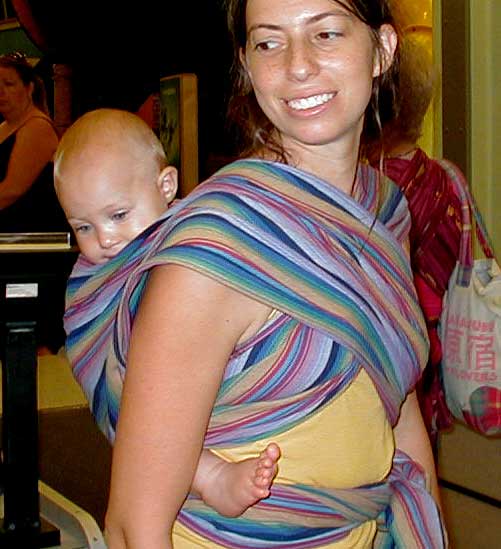
For the first decade or more that Hmong mothers were in Minnesota, I did not see any using strollers, walkers, cell phones, laptops, reading books or magazines, (they were universally illiterate), Walkman appliances, pacifiers, bought toys, teething rings, etc. Babies were always worn on mom, dad, auntie, or grandma in a body-conforming wrap/baby carrier (vs. American-style knapsack with rigid frame back packs). Mothers generally breastfed until 1 year if not longer, only occasionally using bottles and formula given upon hospital discharge. I also observed numerous times that mothers fed each other’s babies when the baby’s mother was away shopping, etc. My own breast fed infant whom I brought with me while I was on home visits was also nursed by Hmong women before I ever heard him wake up or cry. Extended families were the norm. I did not see any bought toys in those first years in Hmong homes. I saw babies without diapers, often not wearing anything in warmer weather (notable skin contact), being carried by numerous family members, talked to and played with by all members of both genders of the extended families. There were no cribs or playpens, high chairs or swings, or hand-held carriers. The babies were often kissed or sniffed - more common - by both sexes of all generations. Until they could walk they were carried while awake, or while sleeping placed on beds on the floor or on mats in the same room as where the adults were visiting. All babies were breastfed. When I brought my own infant during one visit to help the family with paperwork to apply for a visa for another relative, I put him with the other babies on the mat once he fell asleep. Over an hour later I wondered why he had not wakened to nurse, but when I looked over at him, Khou Her was nursing him! Rather than let him cry, and interrupt my ‘more important’ work for her relatives, she fed him. When he had drained one breast she offered her other one to her own baby. When the youngest child was replaced by a subsequent newborn, the grandmother (usually paternal) became the toddler’s primary caregiver, carrying, feeding and bathing the child. A place was made in the grandmother’s bed so that she could continue to care for the toddler even at night. (I need to ask if they also let this baby pacify himself at her breast during this transition away from mother.)
Since I began observing Somali mothers I have seen only 1 baby being worn in a baby carrier or wrap on the mother in 8 years. I have asked and been assured that all babies in previous generations were ‘worn’ on their mothers. I continue to see strollers, pacifiers, cell phones, blue tooth phone ear attachments, laptops, Walkman with ear plugs, mothers driving cars (Hmong women did not drive until much later assimilation), and already owning their own businesses. The babies in the strollers are wearing new clothes, using pacifiers, and toys from local department stores. Many of these women are so economically successful that as of October 2010, they had already attracted the attention of a delegation of businessmen and women, led by Dr. Benny Carson from Sweden, who flew to Minneapolis (where Somali women own a shopping bazaar called Karmel Square) to learn from the them how they had become so business savvy so soon, with the hope of replicating this in Sweden where there is also a large Somali population who have not been as successful there, though they blame the Swedish business laws for much of the delay. I believe I am seeing a group of fiercely independent women. Unfortunately, by adding our 21st century, technological culture to this mix, we have women unconsciously multi-tasking during the earliest bonding opportunities, eager to rejoin or compete with other Somali women in their new-found freedom, social status, and economic independence. The only time I have seen a Somali mother kiss her child was recently in a store after I introduced myself to her and her grossly disfigured daughter. The child had the most profound maxillofacial disfigurement I had ever seen, with a concave nose, convex eye structure, and only 4 webbed fingers on each hand that appeared larger than appropriate for her apparent age (around 2). She could follow me with her eyes, could not smile but did pucker repeatedly, which was quite cute, and when she did that her mother kissed her repeatedly.
This research will not only impact the Somali populations in Minnesota and Sweden, but may, hopefully, change the way we view bonding and attachment. I know I am proposing a paradigm by wading into uncharted waters and this is an unconventional, totally out-of-the-box approach, but perhaps a different look at the problem from a completely different angle is the key to this puzzle. I believe it is.
I do not have a degree in mental health or extensive training in child development studies, but I do have exactly as much experience in the discipline of research as both Jean Liedloff, explorer and author (The Continuum Concept) and Dr. Jane Goodall, British primatologist, ethologist, and anthropologist did when they began their research; none even had a laptop.
When I have completed this research and a curriculum is ready for publication and being implemented which will become a teaching tool for all childbirth educators, labor and delivery nurses, physicians, doulas, midwives, and lactation specialists in Minnesota (and Sweden) next to The Ten Steps of Successful Breastfeeding; when every Somali woman giving birth in Minnesota is using a birthing room unless complications arise, rooming-in with their babies, and nursing beyond the 3 month failure rate (as documented by the Minnesota Women’s Coalition on Breastfeeding, 2007) with a support network in place, what I will have in the end is the satisfaction of knowing that with the help of sponsors and dedicated co-workers we were able to significantly address the fragile maternal-infant attachment in the Somali community, as we see it today. I further believe that others more experienced than I will be able to transfer these findings and thus be able to successfully add our research to the pool of information needed to address and alter how we think about bonding and see a change for the better in our lifetime.
I envision a plan where total bonding education can be added to existing Somali parents’ childbirth education classes in all targeted hospitals; where Somali mothers can be introduced to the importance of bonding during prenatal visits; where prospective Somali couples can tour and be encouraged to request bonding-friendly choices in birthing rooms, rooming-in, and breastfeeding support, all prenatally. I hope to expand these services by disseminating educational tools both in Minnesota and in Sweden by holding seminars simultaneously, and share the information I already have on bonding, and I hope to continue to collect results with the help of the medical community in Minnesota, and then follow the outcomes of these Somali mothers and babies. I hope to collaborate our findings with those working with these same tools in Sweden, both at the beginning of this project and again later in our work.
Wisdom comes only when you stop looking for it and start living
the life the Creator intended for you. - Hopi
* SAAF (Somali American Autism Foundation) reports 1 in every 28 children and rising, not including an estimate of about 3,000 additional ‘closet’ cases in Minneapolis, where parents are not enrolling children in preschool for fear of having them identified with autistic traits, which they already note but wish to deny, though this is being investigated at this time by the NIH.
**For my own purposes I have written a rough assessment tool or bonding grid/rating index©
Stephanie Sorensen
umuliso (Somali for midwife)
BLF ’89, RLM, CLC, CCE, CLE, CPD, CD(DONA)
COMING SOON: This and other stories will appear in Stone Age Babies in a Space Age World:§ Babies and Bonding in the 21st Century© pending by Stephanie Sorensen.
§ This phrase was first coined by Dr. James McKenna, used here with permission and gratitude for his work. A world-renowned expert on infant sleep – in particular the practice of bed sharing, he is studying SIDS and co-sleeping at his mother-infant sleep lab at Notre Dame University. He is the author of “Sleeping With Baby: A Parent’s Guide to Co-sleeping”, 2007, Platypus Media, Washington, D.C.
Humankind has not woven the web of life. We are but one thread within it. Whatever we do to the web, we do to ourselves. All things are bound together. All things connect. Chief Seattle (1780 - 1866)